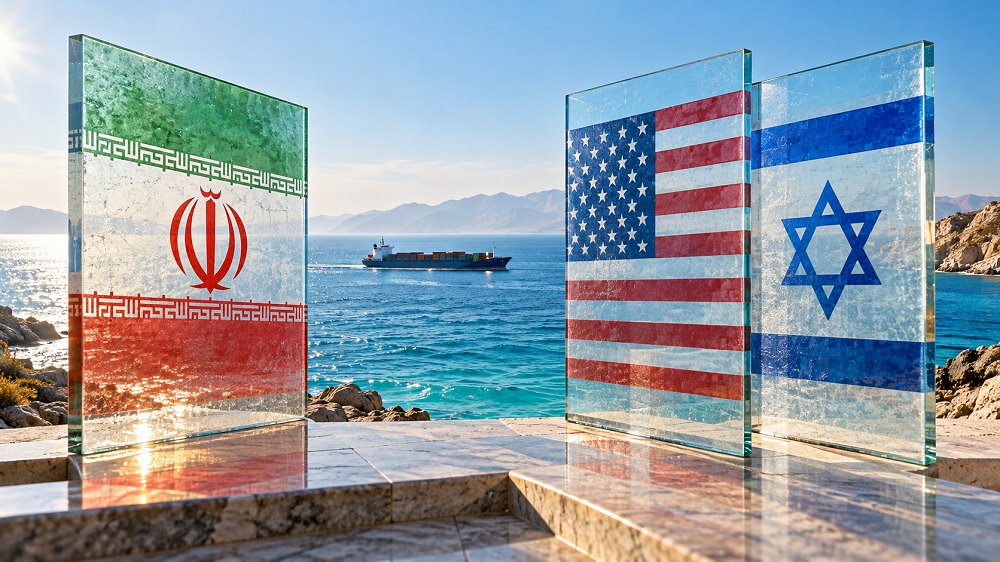
Washington must be treated as a direct participant in this confrontation, alongside Israel. Its military involvement changes the geography of risk and Tehran's calculations. Nevertheless, a public statement does not disclose every component of an operational doctrine. The available account supports an assessment that Iran is broadening its declared deterrent message. It does not independently establish unlimited military reach or an inevitable global conflict. The analytical issue is whether increased uncertainty changes decisions in Washington and Tel Aviv.
Iran-US War and the Changing Meaning of Distance
Conventional regional deterrence allows an adversary to estimate the likely boundaries of retaliation. Removing geographic restrictions challenges that expectation. Tehran's message suggests that distance from Iranian territory would not automatically protect interests connected to an attack. Yet declared scope and executable capability remain different questions. Equipment range, reliable intelligence, access, logistical support and political authorization still shape what any military can accomplish. An expansive warning therefore needs to be assessed against observable preparations rather than accepted as proof of universal reach.
If an Iran-US war resumes with Israeli participation, this broader declared response can be understood as the minimum announced shift in Tehran's planning assumptions. That is a conditional assessment, not a prediction that particular attacks will occur. The scale of the initial assault, the damage sustained, the division of American and Israeli roles, and neighboring governments' conduct would influence Iranian decisions. What has changed is the reliability of assuming that another confrontation would reproduce the boundaries or sequence of an earlier one.
The instruction to update the target bank reinforces this interpretation, but its reported reference to material and nonmaterial assets remains insufficiently specific. It cannot establish a verified list of military, economic or digital targets. Nor does broader deterrence remove obligations to protect civilians. Credibility depends on more than the ability to inflict damage: accurate identification, discrimination and control of unintended consequences also matter. Without those elements, expanding the declared battlefield could generate costs that weaken the political objectives the warning seeks to protect.
From Iran-US War to Security for Everyone or No One
President Masoud Pezeshkian's address to the United Nations General Assembly on September 23, 2026, offers a diplomatic counterpart to this military message. He described regional security as dependent on cooperation and warned that insecurity would be shared. Read alongside the newer remarks, his position suggests that Tehran rejects a security arrangement that excludes Iran. “Security for everyone or no one” captures that interpretation; it should be presented as an analytical summary rather than substituted for his exact words or treated as a published doctrinal formula.
In this framework, an Iran-US war involving Israel would have consequences beyond the immediate combatants. Governments hosting foreign forces, maritime trade routes, energy markets and transport networks could all experience disruption. Tehran's warning appears directed at Washington, Tel Aviv and governments that might facilitate renewed attacks. However, economic exposure, political alignment and military participation are different categories. A country's proximity to the crisis or diplomatic relationship with either side does not by itself demonstrate that it has participated in hostilities.
The Strait of Hormuz illustrates how military pressure could intersect with international economic interests. American deployments and the dependence of multiple economies on maritime commerce give the waterway significance. Claims that it is completely closed, however, require dated, independent shipping evidence and a clear definition of the disruption involved. Even the possibility of interference can influence insurance, commercial routing and market expectations. Those costs would not necessarily fall exclusively on Iran's opponents; Iranian trade and neighboring economies could also suffer.
The distinction matters for interpreting Tehran's security argument. Interdependence can encourage cooperation when governments recognize that protecting commerce serves their shared interests. It can also become an instrument of pressure when each side believes the other will absorb greater losses. Neither outcome follows automatically from a declaration. The practical question is whether regional governments can turn their common exposure into arrangements that reduce the likelihood of escalation.
Wider Deterrence, Negotiation and the Risk of Miscalculation
A third implication for Iran-US war scenarios concerns the relationship between threats and diplomacy. Raising the anticipated cost of an attack may discourage military action. Conversely, Washington and Israel could interpret an expansive warning as evidence that a wider confrontation is already being prepared. That reading could encourage precautionary deployments or preemptive decisions. Deterrence is therefore not strengthened simply by making threats broader. Its effectiveness also depends on how clearly the recipient understands the conditions that trigger retaliation and the options for avoiding it.
The reported insistence that Iran would determine the timing and conditions of a conflict's end expresses a political objective, not guaranteed battlefield control. Adversaries retain agency, while economic pressures, domestic conditions and third countries can influence outcomes. Assessments of endurance should therefore consider public services, military resupply and human costs alongside weapons inventories. The accompanying emphasis on intelligence, technology and personnel support also underlines that sustained deterrence depends on institutions and resources, not statements alone.
For a future Iran-US war involving Israel, the central declared change is Tehran's effort to make a geographically limited response an unsafe assumption. Broader retaliation could be a starting point in a renewed conflict, but its extent and direction remain uncertain. Shared security offers a possible route away from that outcome if translated into communication, reciprocal restraint and credible commitments. If it remains only a language of mutual threat, every government's security could become more fragile.