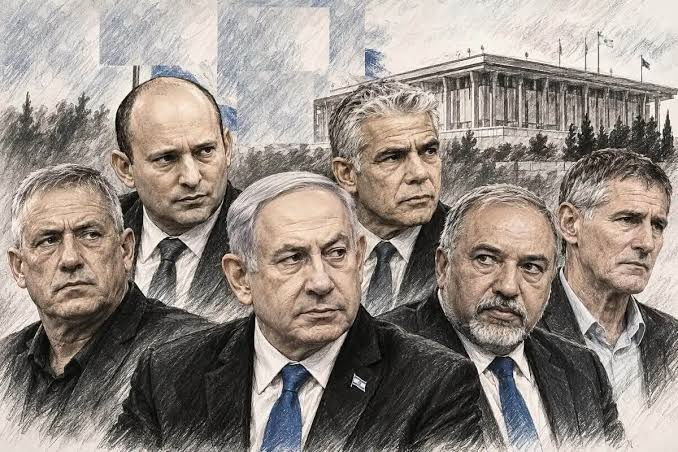
The contest over government formation has become the central issue in the election reports. According to Channel 13, neither major camp commands a parliamentary majority independently. The 19 seats attributed to Arab parties could therefore determine whether the opposition can turn its combined strength into a governing arrangement. For Eisenkot, the challenge extends beyond maintaining opposition to Netanyahu: he must assemble partners willing to support an alternative administration. In the reported distribution, excluding Arab representatives would leave his camp without the numbers needed for that project.
Channel 13 assigns Netanyahu’s camp 53 seats and Eisenkot’s 48. Adding the Arab parties’ seats to Eisenkot’s total produces 67, above the 61-seat majority threshold in the 120-member Knesset. A coalition with Arab parties could consequently bridge the gap between parliamentary minority and a viable governing majority. Yet the same report says roughly 600,000 votes in double envelopes remain outside this calculation. Its reference to a complete count should therefore not be treated as confirmation of a final seat allocation. The political assessment remains conditional on the reported balance holding.
For Arab parties, the Israel elections 2026 could create an opportunity to influence the choice of prime minister directly. Their reported parliamentary weight would move them from the margins of competition into the centre of government negotiations. Arithmetic alone, however, does not establish a political agreement. Eisenkot would need to secure support through negotiations and reciprocal commitments. A coalition with Arab parties becomes a practical proposition only when participants agree on the form of cooperation, government priorities and their respective responsibilities. Their seats cannot simply be entered into the opposition’s column without their consent.
Ahmad al-Tibi’s remarks indicate that at least some Arab representatives are prepared to engage. His assertion that Eisenkot’s camp could form a government if it showed courage places responsibility on opposition leaders to make a political decision. Yousef Jabareen’s stated willingness to help clear the way for Netanyahu’s removal points in the same direction. These declarations strengthen the prospects for talks, but neither amounts to a completed parliamentary agreement. Negotiations must still close the distance between expressing readiness to assist and committing to support a particular government.
Yair Golan, leader of the Democrats, has argued more explicitly for Arab participation in a replacement government. According to Yedioth Ahronoth, he declared that Netanyahu’s opponents held a majority and called for action. His position demonstrates that a coalition with Arab parties has outspoken supporters within the opposition. Nevertheless, his comparison of 65 seats against 55 differs from Channel 13’s reported balance of 67 against 53. That discrepancy cannot be resolved by assumption. It reinforces the need to distinguish a potential opposition majority from a verified final distribution of seats.
Channel 12’s account of Netanyahu’s strategy targets precisely this opening. The first reported component is an effort to delegitimise reliance on Arab parties in forming a government. Such a campaign could raise the political cost of cooperation for Eisenkot and his partners, exposing them to public pressure and internal disagreement. In the Israel elections 2026, Netanyahu would not necessarily need an immediate increase in his own support to benefit. Preventing his opponents from assembling a coherent majority could preserve his room for manoeuvre and obstruct the emergence of a replacement administration.
Splitting the change camp: Could a coalition with Arab parties tear it apart?
The second reported component is an attempt to divide the change camp, with Naftali Bennett identified as the first target. Its connection to the campaign against Arab participation is clear: disagreement over cooperation could weaken opposition cohesion. A coalition with Arab parties therefore requires Eisenkot to negotiate on two fronts, securing Arab support while keeping his existing partners committed. Failure on either front could neutralise the available parliamentary numbers. Shared opposition to Netanyahu would then remain insufficient to deliver a government capable of replacing him.
The formation process also imposes deadlines. Under the procedure described in the Channel 12 report, the first candidate receives 28 days to form a government, with a possible 14-day extension. If unsuccessful, a second candidate receives 28 days without an extension. A coalition with Arab parties would need to progress from declarations of readiness to dependable commitments within those windows. Protracted disagreements could consume the available time while increasing pressure on prospective partners. Parliamentary strength acquires practical value only when it can sustain an agreement during the allotted formation period.
According to the same account, failure by the second candidate opens a 21-day Knesset stage. During that period, 61 lawmakers can support another candidate, whom the president then gives two weeks to form a government. Failure would lead to dissolution and another election within 90 days. Channel 12 also identifies October 29 as the counting deadline, November 4 for final results and November 10 for the new Knesset’s opening. Those dates are reproduced here as reported, rather than independently established milestones for the Israel elections 2026.
A repeat election, the third element attributed to Netanyahu’s strategy, increases the significance of opposition negotiations. Deadlock could give him another competitive opening, although its outcome cannot be predicted. Conversely, a coalition with Arab parties could turn the opposition’s current potential into an alternative government. Eisenkot’s route to the premiership depends on bringing those seats together under a sustainable agreement. If the reported balance survives the final count, the outcome of the Israel elections 2026 will hinge on whether opposition leaders accept Arab participation as a foundation for governing.