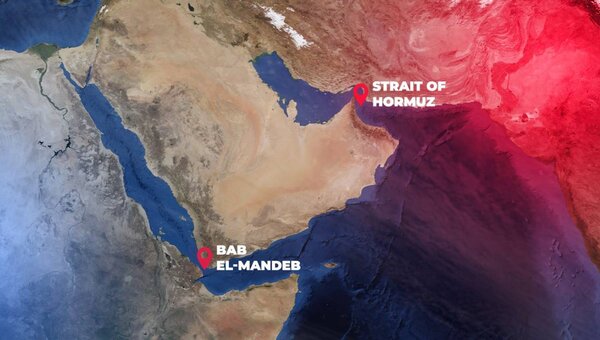
Yet influencing trade is different from controlling the global economy. The Houthis can raise transit risks, but they cannot determine market responses, foreign intervention or Iranian decisions. The central question is therefore not who owns the sea. It is how maritime threats translate into political concessions, and when the costs of maintaining those threats begin to exceed their benefits.
Bab el-Mandeb Strait: Disruption Beyond Territorial Control
The passage connects the Red Sea with the Gulf of Aden and, through it, the Indian Ocean. It forms part of the trading route linking Asia and Europe through the Suez Canal. This geography gives an actor capable of threatening shipping influence disproportionate to its economic size. For the Houthis, participation in this equation can elevate a force rooted in Yemen's domestic conflict into an actor affecting international security. Such influence, however, does not automatically produce diplomatic recognition or international legitimacy.
On October 30, 2026, the Norwegian Maritime Authority maintained its highest applicable shipping security level for the Bab el-Mandeb Strait. At the same time, it assessed that the pattern of attacks indicated a lower risk of indiscriminate attacks against international commercial shipping than earlier assessments suggested. Both findings matter. A serious threat can persist without continuous attacks on every vessel, and heightened security requirements should not be confused with evidence that the passage is completely closed.
Houthi leverage can operate within this intermediate condition. If shipping companies consider an attack plausible, they must evaluate insurance, protection, departure schedules and routing even on days without violence. Nevertheless, developments along the coast and nearby islands remain relevant. Reports of changing positions mean that claims of complete, lasting territorial control require continued verification. Possessing the ability to threaten a shipping lane and exercising stable authority over all surrounding territory are distinct forms of power.
Hormuz and Bab el-Mandeb Strait: Pressure on Washington and Its Allies
Hormuz and this passage do not perform identical functions. Hormuz provides the Persian Gulf's maritime outlet, while the Red Sea also connects northward to the Suez Canal. Insecurity in one cannot simply be treated as equivalent to closure of the other. Their relationship matters because disruption narrows affordable alternatives. When one route becomes unsafe, another becomes more valuable. If the alternative also faces threats, rerouting becomes more expensive and maintaining predictable trade becomes harder.
From this perspective, the Bab el-Mandeb Strait can offer Iran complementary leverage. During renewed confrontation, Washington would need to consider not only the protection of its forces and interests but also commercial disruption and allied concerns. Israel and Arab governments connected to these maritime routes could face different forms of exposure. Their responses would not necessarily converge: some might favor stronger protection or military action, while others could prioritize negotiations, mediation or arrangements intended to keep their territory outside the conflict.
For the Houthis, this position is valuable beyond supporting Tehran. The group pursues domestic, security and political objectives of its own, and maritime pressure could strengthen its negotiating position over Yemen. Iranian support and strategic alignment do not independently prove that every operational decision follows a direct order from Tehran. Careful analysis must distinguish shared interests, possible coordination and command authority. Otherwise, it risks attributing a single decision-making structure to actors whose priorities may overlap without being identical.
Iranian advantage should therefore be understood as an ability to increase the cost of pressure against Tehran, rather than a guaranteed means of determining a war's outcome. Even if Washington must divide attention and resources, it retains military, diplomatic and economic options. Disruption affecting neutral countries could also weaken sympathy for Iran's position. An initial bargaining advantage may consequently generate political costs, particularly when governments perceive commercial pressure as indiscriminate or unrelated to their own conduct.
Bab el-Mandeb Strait: Economic Leverage and Political Limits
ACLED's analysis of recent developments emphasizes selective coercion and a persistent threat rather than the necessity of constant, maximum disruption. This distinction helps explain a possible Houthi calculation: narrower targeting can maintain pressure on a particular opponent while reducing the likelihood of a broader international response. Identifying commercial connections, however, is complicated. Ownership, flag, management and cargo can point to different jurisdictions, and errors or expansive definitions can pull additional states and companies into the crisis.
Economic effects travel through higher insurance and protection costs, longer voyages, additional fuel consumption and delayed deliveries. Their severity depends on the duration of insecurity, the number of affected vessels and the capacity of alternative routes. A new threat does not automatically mean an oil-price surge or a paralyzed supply chain. Companies and governments can adjust schedules, build inventories and diversify transport arrangements. Such adaptation does not eliminate disruption, but it can reduce the durability of coercive leverage.
The future of the Bab el-Mandeb Strait depends partly on whether threats produce agreements or a continuing cycle of attack and retaliation. The Houthis and Iran may use maritime vulnerability to increase their political weight, but human costs in Yemen, regional commercial losses and foreign responses impose limits. The central asset is not ownership of the global economy's pulse. It is the capacity to raise the cost of disregarding their interests. Whether that capacity endures will depend on political results, not simply the intensity of threats.