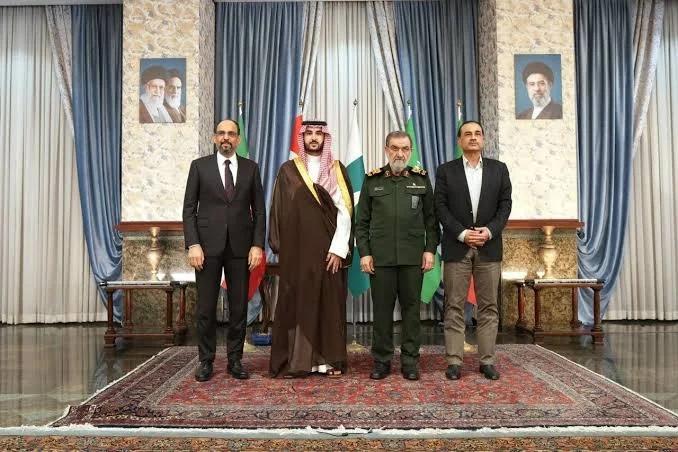
The October 26 visit brought Saudi Defence Minister Khalid bin Salman, Pakistani army chief Asim Munir and Turkish intelligence chief Ibrahim Kalin together with Iranian officials. The delegation’s composition suggests discussions connected to threat assessments, military calculations and crisis management. Its senior security profile does not, however, establish that an ultimatum was delivered or a secret agreement reached. The publicly reported outcome was a series of discussions with Masoud Pezeshkian, Abbas Araghchi and Mohsen Rezaei, followed by an agreement to continue consultations.
Nor was the visit entirely unannounced. According to Ali Bagheri’s explanation, the proposal had been raised during Munir’s previous trip. Limited advance publicity must therefore be distinguished from an absence of prior coordination. For Mecca Pact members, travelling together offered an opportunity to present security concerns through a coordinated approach. For Iran, receiving all three delegations created space to influence their assessment of the crisis. These overlapping interests give the encounter significance beyond separate bilateral relationships, without establishing that the participants share an identical regional agenda.
Scenario 1: The Tehran meeting as a channel for averting war
The first scenario is an effort to prevent renewed fighting involving Iran, the United States and Israel. Saudi Arabia’s stated support for de-escalation and diplomatic solutions is consistent with that interpretation. Published accounts also identify Pakistan as a mediation channel. Within this framework, the delegation’s role could involve clarifying positions and identifying measures that lower the risk of confrontation. Mediation, however, can deliver results only if the principal parties are prepared to implement reciprocal commitments. Opening a channel is a preliminary step, rather than evidence that their underlying disagreements have narrowed.
Reports surrounding the Tehran meeting have discussed shipping security in the Strait of Hormuz, economic pressure on Iran and the war in Yemen together. Mecca Pact members may consequently be exploring a phased understanding linking reduced security threats to diplomatic or economic openings. This remains an analytical possibility, however, rather than a confirmed negotiating package. No detailed joint proposal has been publicly released, and the available information does not establish that all participants have agreed to connect these issues. Each file also involves actors whose cooperation cannot automatically be assumed.
The central obstacle to such an understanding would be the sequence of measures and the credibility of guarantees. If one side demands immediate action while postponing its own obligations, negotiations could stall. Euronews, drawing on reporting by Amwaj Media and the Guardian, has highlighted disagreements over sequencing. Shortening implementation periods would not necessarily resolve that problem. The more consequential question is how each party can be confident that a concession will receive a corresponding response. Without sufficient reassurance, even a technically workable timetable may struggle to secure political approval or survive implementation.
Scenario 2: The Tehran meeting as a negotiation over mutual restraint
The second scenario centres on managing reciprocal threats. In this interpretation, negotiations complement deterrence by allowing participants to communicate their interests and discuss ways to prevent escalation. Iran may likewise seek to clarify which actions it would regard as direct threats. Such communication matters because it can reduce the danger of miscalculation: a limited measure by one party might otherwise be interpreted by another as preparation for a broader attack. Establishing clearer expectations could therefore serve a practical purpose even without producing a comprehensive political settlement.
In this framework, the Tehran meeting could help distinguish manageable disagreements from security red lines. For Mecca Pact members, Saudi security and preventing the conflict from spreading are important concerns. For Iran, neighbouring countries’ behaviour during an intensified confrontation would also matter. Yet no public document establishes an agreement on airspace access, guarantees against attack or reciprocal defence obligations. Attributing those outcomes to the discussions would go beyond the available evidence. The plausible objective is a better understanding of positions and less uncertainty, rather than assuming that specific security arrangements have already been concluded.
Yemen belongs within the same calculation. Reports describe concerns about Houthi attacks on Saudi Arabia, but Tehran’s relationship with the group should not be equated with complete control over its decisions. Even if Iran can contribute to de-escalation, a durable understanding would also depend on Yemeni actors’ calculations and demands. Any prospective arrangement that disregards their decision-making autonomy could therefore encounter implementation problems. Expectations about Iranian influence would need to reflect those limitations, particularly if participants were considering reciprocal steps whose continuation depended on developments inside Yemen.
Scenario 3: The Tehran meeting as the start of a lasting security channel
The third possibility is that an episodic exchange develops into a continuing mechanism for managing disagreements. The closing statement’s commitment to further discussions keeps that option open, although it does not itself establish an operational arrangement. For Mecca Pact members, a regular channel could make communication easier during crises. Iran could use it to present regional proposals and explain its concerns. Dialogue with a defence grouping does not, however, imply membership, strategic alignment or an undertaking to defend Iran. Those would require commitments that have not been publicly demonstrated.
The Tehran meeting should ultimately be assessed through follow-up contacts, a defined agenda and measurable steps. If exchanges remain confined to restating positions, their practical value will diminish. Conversely, agreed crisis communications or reciprocal de-escalation measures would indicate progress. The Tehran meeting sits at the intersection of diplomacy and deterrence: Mecca Pact members have an opportunity to help contain the risk of war, while Iran can raise its concerns directly. The outcome will depend on subsequent commitments and implementation, rather than the significance attached to the visit alone.