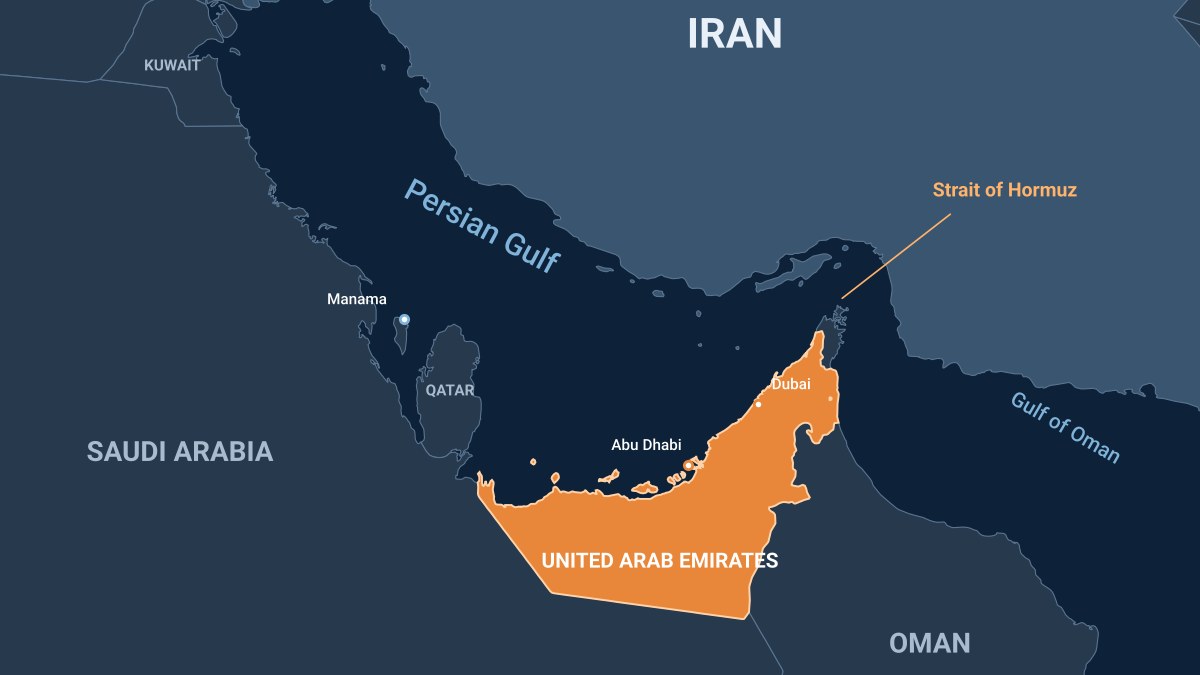
For Abu Dhabi, opposing another confrontation involving Iran, the United States and Israel does not mean accepting Tehran's policies. Concern about a neighbor's military capabilities can coexist with concern about the consequences of attacking that neighbor. The UAE's position sits between deterrence and war prevention. Five considerations help explain it: infrastructure vulnerability, a service-oriented economy, trade insecurity, differing priorities among partners and the difficulty of ending a crisis once military operations begin.
Persian Gulf Security and an Economy That Needs Predictability
The first consideration is the difference between defensive capability and complete immunity. Military preparedness should not be mistaken for the elimination of every risk. Even if most threats are intercepted, possible disruption at an airport, port, energy facility or public-service network can affect government and business decisions. Defense should therefore be assessed beyond interception numbers. The costs of sustained readiness, continuity of services and the confidence of residents and investors also matter when evaluating the consequences of another confrontation.
A second consideration for Persian Gulf security is the UAE economy's dependence on reliable flows of passengers, investment, goods and services. For an economy whose reputation rests partly on international connectivity, uncertainty can impose costs before physical damage occurs. Companies might postpone expansion, travelers could choose different routes and investors may demand higher returns for accepting additional risk. These are potential consequences of escalation, not claims that every such adjustment is already taking place.
The third consideration is maritime commerce. Anxiety about Hormuz concerns more than oil exports: supplies, delivery schedules, insurance and transport planning are also involved. Even without a complete closure, changing risk assessments can make economic activity more expensive. Higher energy prices would not necessarily compensate an exporter for every consequence. Additional revenue per unit must be assessed alongside sales volumes, commercial costs and losses elsewhere in the economy. A price increase is therefore an incomplete measure of national economic advantage.
Persian Gulf Security: Why Allies Do Not Always Share Priorities
The fourth consideration is the difference between the actors' priorities. The United States, Israel and Arab governments may share concerns about some Iranian behavior, but their proximity to the conflict, economic structures and preferred outcomes differ. An operation considered limited by one participant could initiate prolonged emergency readiness for Iran's neighbor. Security cooperation with Washington should consequently not be interpreted as automatic approval of every American or Israeli military decision. Shared partnerships do not erase differences over acceptable costs.
In this context, Persian Gulf security does not present the UAE with a simple choice between Iran and America. Abu Dhabi can maintain defense relationships with external partners while seeking lower tensions with Tehran. If supported by clear, verifiable commitments, this can represent a broader diplomatic toolkit. But if either side interprets the approach as concealed support for its adversary, misunderstanding becomes more likely. The balance depends on credible behavior rather than assurances alone.
Nor should one Emirati official's remarks automatically be treated as the identical position of every Arab government. Regional countries differ in their relations with Iran, threat exposure, defensive capacity and economic dependencies. At the same Manama forum, Bahrain discussed a regional security framework potentially open to Iran if specified principles were respected. That represents a proposed political pathway, not proof that a regional agreement already exists or that outstanding disputes have been resolved.
The message for Tehran is also mixed. Neighbors' fear of war can create an opportunity for dialogue, but should not be mistaken for acceptance of pressure against them. Greater threats to regional infrastructure or commerce could encourage governments favoring mediation to deepen defensive cooperation with external powers. The ability to impose costs does not invariably produce greater political influence. How that ability is used can reverse the expected advantage, particularly if neighboring governments conclude that restraint has failed to protect their interests.
Persian Gulf Security After an Attack: The Problem of Ending the Crisis
The fifth consideration is the distance between launching operations and ending their consequences. Gargash warned that military solutions would not provide quick exits from the existing complex situation. This raises a practical question: even if an attack reaches its stated targets, what prevents retaliation, geographic expansion and another round of operations? The capacity to destroy a target does not necessarily provide a plan for managing the following day. Tactical success and a sustainable political outcome are different achievements.
Preparedness for the worst and support for diplomacy can be complementary. Defense raises the cost of an attack, while communication can reduce the likelihood of reaching that point. Calls for negotiations alone, however, are insufficient. Reducing misunderstandings, maintaining contact during emergencies and clarifying reciprocal commitments all matter. Arrangements should address concerns about attacks, operational support and threats to commerce, without treating smaller countries' rights as bargaining material in negotiations between larger powers.
The future of Persian Gulf security depends on whether the actors regard deterrence as a foundation for agreement or a permanent substitute for it. The UAE's position does not abandon concern about Iran; it recognizes that another war could reproduce those concerns in a more expensive form. Regional policy should be judged not only by damage avoided on a particular day, but by whether it creates conditions in which trade, ordinary life and interstate relations are not repeatedly unsettled by the prospect of another attack.